
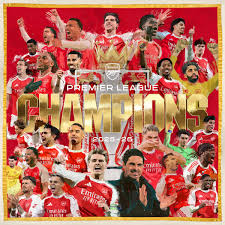
There was no last-gasp winner at the Emirates, no champagne sprayed in front of the home crowd, and no coronation staged for television. Instead, Arsenal’s return to the Premier League summit arrived the way modern title races so often do: by remote control, in a training-ground lounge, with players glued to a screen and staff trying to look calm while their pulses did anything but.
When Manchester City were held to a 1-1 draw at Bournemouth, the arithmetic snapped into place, and the wait ended. Arsenal are champions again, for the first time since the club’s unbeaten “Invincibles” season of 2003-04, closing a 22-year loop that has felt, at times, like an entire era of English football.
For Mikel Arteta, the moment carried the particular weight of a project measured in seasons, not weeks. His team has lived on the edge of this achievement, finishing second three years in a row before finding the final step. This time, they did not need permission from anyone; they simply outlasted the league’s most relentless machine.
A title won in the margins
Arsenal’s season will not be remembered for a single defining afternoon so much as for a steady accumulation of small wins: game management, set-piece precision, and a defensive base that rarely wobbled for long. The loudest compliment, and occasionally the sharpest criticism, has been that they looked built for the long haul. When matches tightened into one-goal tests, Arsenal often appeared more comfortable than their opponents, and that steadiness turned into points.
Even the stumbles that threatened to reopen old scars did not derail them. A spring defeat away to City, framed at the time as the decisive swing, briefly shifted the mood and the momentum. Arsenal’s response was not spectacular, but it was mature: fewer gifts, fewer panicked minutes, and a return to the principles that have made Arteta’s side so difficult to play through.
The end, fittingly, arrived without drama from their own boots. Bournemouth did Arsenal a favour by taking something from City, and Arsenal did themselves the bigger one by keeping the title race within their control long enough for that result to matter.
Arteta’s second major prize, and the sense of a club reassembled
Arteta’s tenure has often been assessed as if it were a negotiation between aesthetics and outcomes. The football has evolved, sometimes sharply, sometimes subtly: from rigid early structures to a more adaptable side capable of winning ugly when the schedule bites. Now he has the outcome that reshapes every conversation. Sky Sports noted this as his second major honour as Arsenal manager, a line that reads plainly but lands heavily in a club that has spent years measuring itself against the very top.
What stands out is not only the destination, but the way Arsenal have built a squad that feels aligned. The captain, Martin Ødegaard, has become the public face of their composure, while Declan Rice’s arrival brought a kind of authority through the middle that titles tend to demand. Their celebrations, captured as they watched events unfold, told the story of a group that has carried the tension together rather than letting it splinter them.
There is also, inevitably, the longer emotional geography of Arsenal’s fan base: the years spent watching rivals lift trophies, the “nearly” seasons that hardened into jokes, the pressure that accumulates when expectation returns. Ending that cycle changes the club’s self-image overnight. Winning a league title is not simply a medal; it is a reset button.
Selhurst Park awaits the formalities.
The Premier League trophy will be presented after Arsenal’s final match of the season at Crystal Palace, which gives this title an unusual rhythm: the joy first, the pageantry later. That delay can be torturous, like being asked to hold your breath after surfacing, but it also offers Arsenal the chance to savour what they have done without immediately rushing into a staged finale.
For supporters, it sets up a London finale that will feel like a street party funnelled through turnstiles, with red shirts on trains, packed pubs, and that particular nervous laughter that only comes when something has been waited on for too long to fully trust. For the players, it is a chance to lift the trophy together, in public, in a moment that belongs to them.
One more chapter still to be written.
Yet this season is not finished with Arsenal. They have a Champions League final ahead, against Paris Saint-Germain in Budapest at the end of May, and the timing is curious: a team freed by the league’s conclusion, but faced with the sharpest single-match test European football offers.
There is a temptation to treat that final as a bonus, a swing taken with relaxed shoulders. But winning the league can also sharpen hunger. Titles do that. They remove the fear of failure and replace it with the fear of letting an opportunity slip when you know you belong at the table.
For now, though, Arsenal have achieved what modern Premier League history makes brutally difficult. They have outlasted City across a season, navigated the pressure of expectation, and turned persistence into silverware. The wait is over. The questions will change. And the rest of the league, starting next season, will have to deal with a simple new reality: Arsenal are no longer chasing the champions. They are the champions.